Cyber Army
Initiative
Nigeria's military and paramilitary agencies each have cyber units. None of them formally talk to each other. When a threat actor hits one — the others don't know. That's not a resource problem. It's a structural one. And it has a solution.
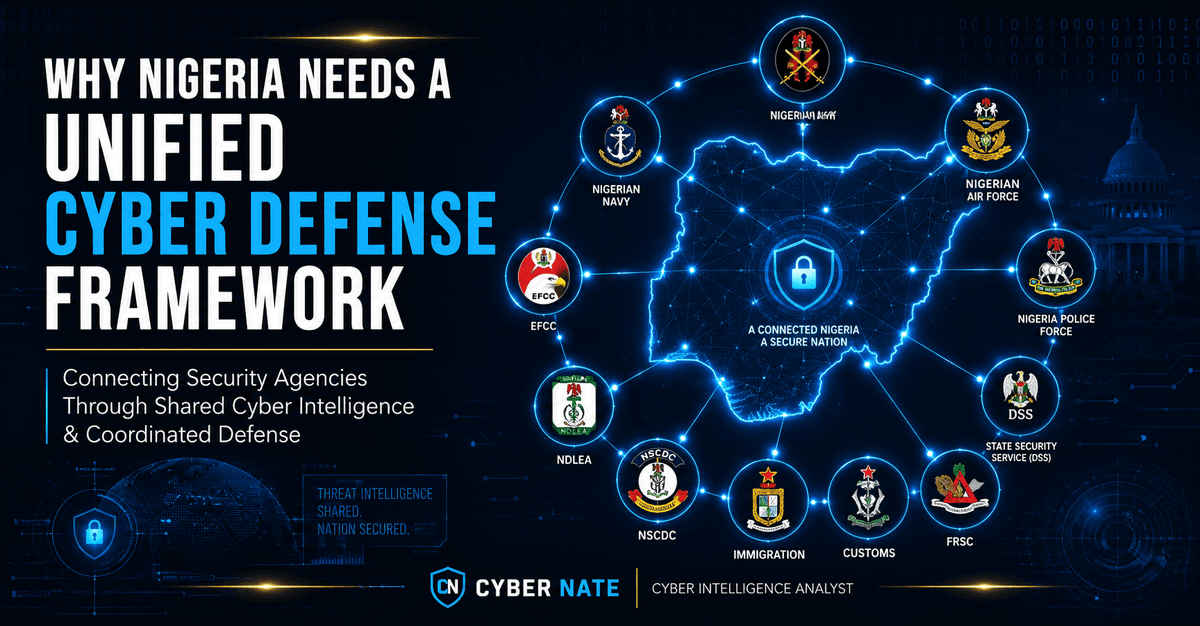
Nigeria has cyber units.
It doesn't have coordination.
In early 2025, a coordinated phishing campaign targeted multiple Nigerian government institutions simultaneously. Each targeted agency detected something anomalous — a suspicious email domain here, an unusual login attempt there. What happened next tells you everything about where Nigeria's cyber defense stands today: nothing was shared between them.
Each agency handled its own fragment of the picture while the attackers moved freely across the full canvas. This is not an isolated failure. It is the structural reality.
Nigeria's National Cybersecurity Policy and Strategy (NCPS 2021) and the Cybercrimes (Prohibition, Prevention, Etc.) Act 2015 both acknowledge the need for inter-agency coordination. CAI is proposed as the practical implementation mechanism for what existing policy has already called for — but not yet delivered.
No shared intelligence
Threat intel discovered by one agency is rarely shared with others, allowing threat actors to exploit multiple agencies simultaneously.
No coordinated response
Cyber incident response is reactive and uncoordinated — there is no joint rapid-response capability at the national level.
Inconsistent training
Cybersecurity training standards vary wildly between agencies, leaving significant skill gaps that adversaries actively exploit.
No cyber command
Nigeria lacks a recognised national cyber command structure comparable to US Cyber Command, the UK NCSC, or Israel's Unit 8200.
Eight components.
One connected ecosystem.
CAI does not seek to dissolve existing agency cyber units — it seeks to connect them into a single operational ecosystem greater than the sum of its parts.
Central Cyber Command & Coordination Unit
The operational nerve centre — inter-agency coordination, joint mission planning, policy enforcement, and national cyber situational awareness.
CAI Cybersecurity Training Academy
Modular, role-specific training for all agencies — SOC operations, OSINT, digital forensics, ethical hacking, threat intelligence analysis.
Joint Security Operations Center (JSOC)
Shared 24/7 monitoring facility providing unified visibility across all participating agencies' networks, staffed on a rotational basis.
Threat Intelligence & Monitoring Division
Structured sharing using TLP and STIX/TAXII protocols. National threat registers, TTP tracking, actionable intelligence reports for agency leadership.
Digital Forensics & Incident Response (DFIR) Unit
Rapid-response forensics and IR capability serving all agencies — first responder for major cyber incidents affecting government infrastructure.
Research & Innovation Lab
Indigenous cybersecurity research, Nigeria-specific threat intelligence tools, emerging technology testing, university collaboration, and published findings.
Inter-Agency Cyber Exercise Program
Regular joint cyber drills, tabletop exercises, and red team/blue team engagements simulating real-world national-level incidents.
National Cyber Awareness Campaign
Government-wide digital hygiene campaigns targeting civil servants, security personnel, and the public — reducing the human attack surface.
From concept to institution.
A four-phase roadmap spanning five years — from stakeholder engagement and pilot training to full institutionalisation and ECOWAS-level regional expansion.
- Publish White Paper
- Stakeholder awareness and engagement
- Identify agency champions
- Establish CAI Secretariat
- Draft inter-agency MOU framework
- Launch CAI Training Academy with 3–4 pilot agencies
- Activate basic threat intelligence sharing
- Conduct first joint cyber exercise
- Activate Joint SOC and DFIR Unit
- Onboard all target agencies
- Publish first national cyber threat report
- Establish Research Lab university partnerships
- Seek formal legislative backing
- Pursue ECOWAS regional expansion
- Attract international partnerships and donor funding
- Establish CAI as permanent national institution
Built for every arm of Nigerian security.
CAI is designed to serve all Nigerian military and paramilitary security agencies. Initial engagement will focus on agencies with existing cyber infrastructure.
Built from inside the system.
CAI is proposed by a practitioner who works simultaneously in government law enforcement intelligence and private sector SOC operations — a vantage point that shaped every component of this framework. This is not a think-tank proposal written from the outside.

SOC Analyst · NexSecure Cybersecurity
Founder · Cyber Nate
Article 1 is published on LinkedIn.
"Why Nigeria Needs a Unified Cyber Defense Framework" — the case for CAI, the problem with fragmentation, and the case for coordination. Discussion active, generating engagement from digital transformation and engineering leaders.
This is an invitation to dialogue.
If you are a decision-maker in Nigerian law enforcement, national security, or technology policy — and you believe coordinated cyber defence matters for Nigeria — this is a conversation worth having.