Infostealers are quietly one of the most consequential malware categories in circulation today. Unlike ransomware, they don't announce themselves — they run silently, harvest everything of value on a device, exfiltrate it, and often clean up after themselves. Most victims never know they were infected until their credentials show up for sale or their accounts are taken over weeks later.
How infostealers get in
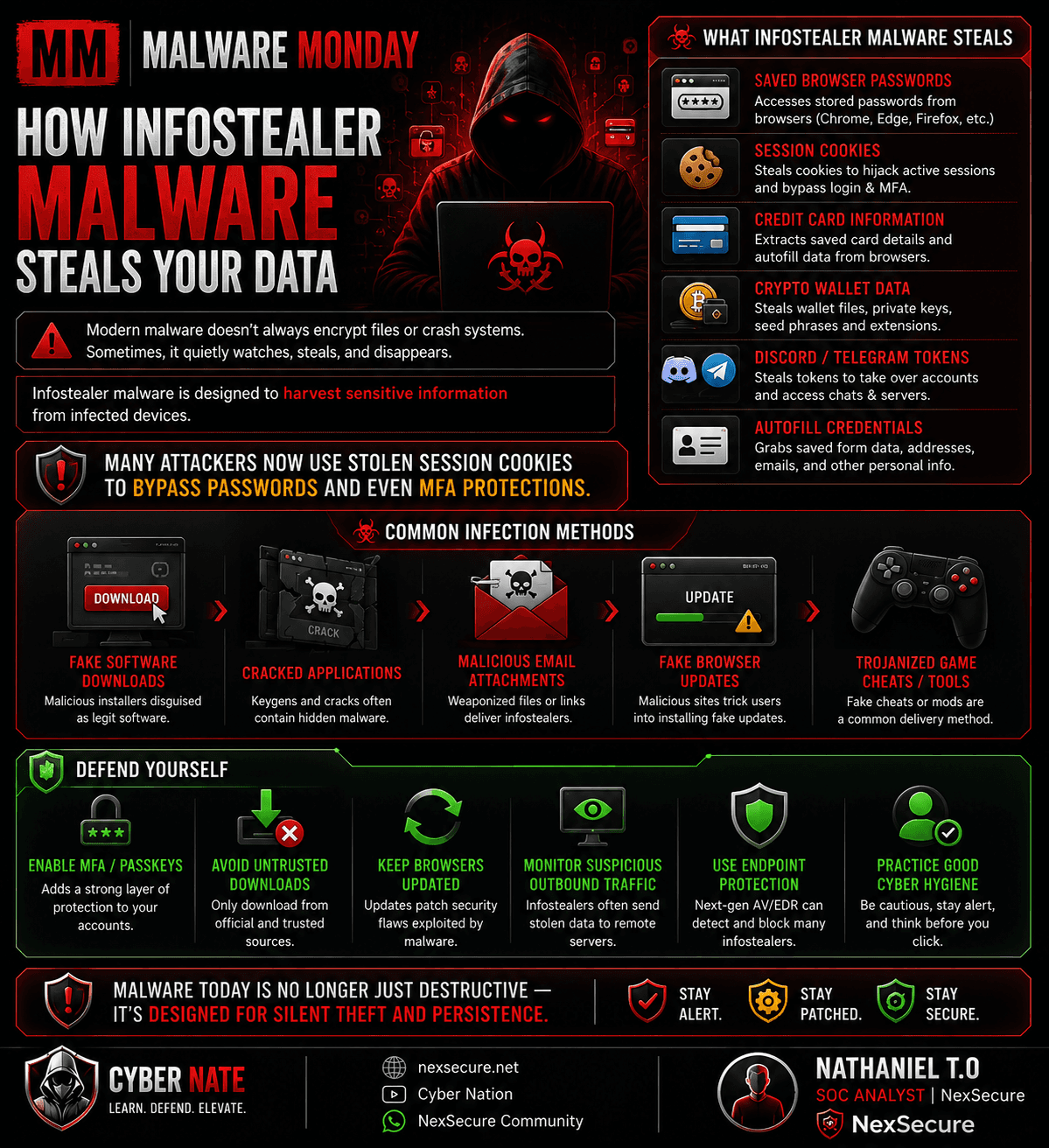
The most common delivery paths are still the boring ones: cracked software and game cheats bundled with a payload, malicious ads on search engines (malvertising) that impersonate legitimate download pages, and phishing emails carrying a disguised loader. Infostealers are frequently distributed as Malware-as-a-Service, meaning the person who builds it and the person who spreads it are often different actors entirely — which is part of why the ecosystem is so resilient.
What they actually steal
- Browser data — saved passwords, autofill data, and session cookies, which can let an attacker log into an account without ever needing the password.
- Cryptocurrency wallets — browser extension wallets and local wallet files are a priority target.
- Application sessions — Discord, Telegram, and Steam tokens, often used to pivot into further social-engineering campaigns against the victim's contacts.
- System fingerprint — installed software, hardware IDs, and screenshots, used to build a profile for resale on stealer-log marketplaces.
Co-published with NexSecure Cybersecurity · Nathaniel T.O, SOC Analyst
Defending against infostealers
Because infostealers primarily target what's already saved in your browser, the single highest-leverage defense is to stop storing credentials there. A dedicated password manager, hardware security keys for your most important accounts, and endpoint detection that flags unusual outbound connections close most of the gap. For organisations, monitoring stealer-log marketplaces and dark-web credential dumps for your own domain is now a standard part of a mature SOC's threat intelligence workflow.
Key takeaways
- Infostealers steal sessions, not just passwords — a strong password does not stop cookie theft.
- Cracked software and malvertising remain the top two infection vectors.
- Credential monitoring services are now essential, not optional, for organisations of any size.