For decades, password complexity was treated as the cornerstone of digital security. In 2026, that assumption is outdated. Attackers rarely spend time guessing passwords anymore — a 20-character password provides no protection if malware steals the session cookie sitting in your browser, or if you approve a fraudulent MFA push notification without thinking twice.
Why strong passwords fail
Modern attackers route around password strength entirely, using techniques that make the password itself irrelevant:
- Infostealer malware — harvests saved passwords and active session cookies directly from the browser.
- Adversary-in-the-middle phishing proxies — tools like Evilginx sit between the victim and the real login page, capturing session tokens even when MFA is enabled.
- MFA fatigue / push bombing — bombarding a user with approval requests until one is accepted out of frustration or confusion.
- Session hijacking — reusing a stolen browser token to skip authentication entirely.
What actually protects you now
Security has shifted from "how strong is the password" to "can the credential be phished or replayed at all." That shift favours a specific set of controls: passkeys and hardware security keys (both resistant to phishing because they're cryptographically bound to the real domain), conditional access policies that evaluate device health and location before granting access, endpoint detection that catches the malware before it can steal a session in the first place, and a Zero Trust model that assumes no login — however credentialed — is automatically trustworthy.
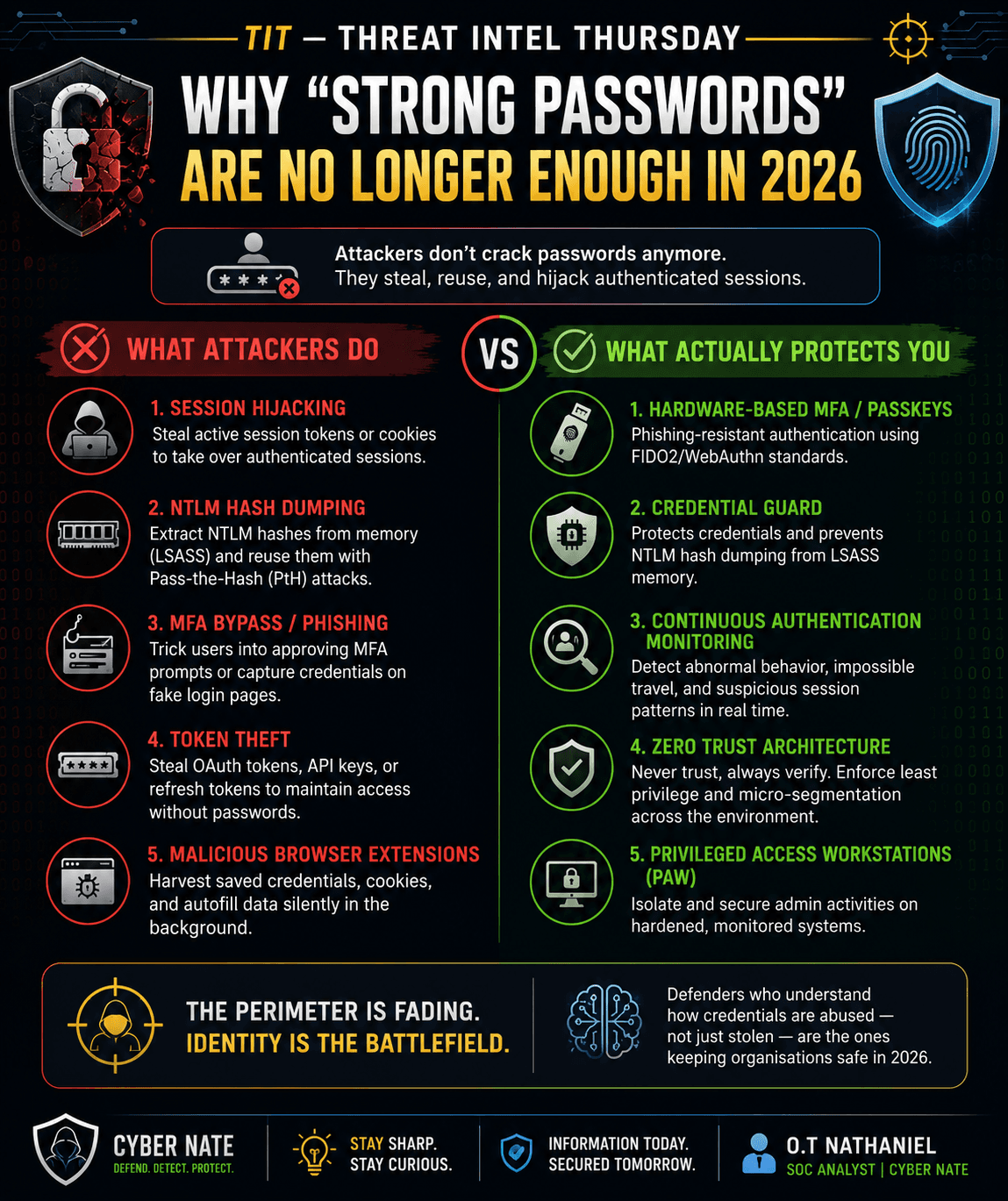
Co-published with NexSecure Cybersecurity · Nathaniel T.O, SOC Analyst
Final thoughts
Passwords are no longer the primary battlefield — identity is. Organisations that keep investing solely in password policy while ignoring session security, phishing-resistant MFA, and endpoint visibility are defending a perimeter attackers stopped attacking years ago.
Key takeaways
- A strong password does not stop session-cookie theft or MFA fatigue attacks.
- Phishing-resistant authentication (passkeys, hardware keys) should replace SMS and push-based MFA where possible.
- Identity — not the password — is now the primary attack surface worth defending.